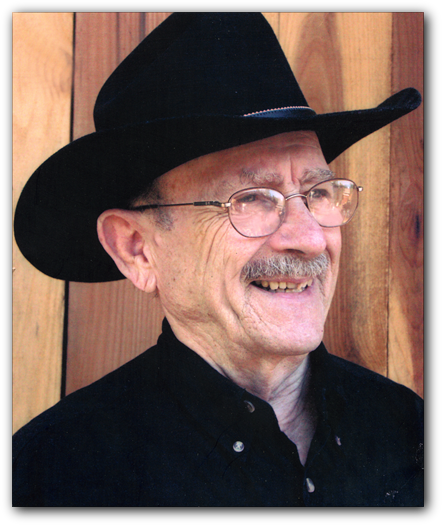
Charles 'Charlie' Hull
April 25, 1928 –
Inducted March 7, 1982 #0029
Born in rural Missouri at the beginning of the big depression, Charlie’s earliest memory of music is the railroad, cowboy and hillbilly songs his dad and friends would play and sing. At the height of the depression his family moved to Des Moines, Iowa where work was available, and their musical tastes broadened to include all kinds of music. The radio and phonograph were on most of the time, the music ranging from Grand Ole Opry to popular swing bands.
Charlie built a crystal set radio, and with his earphones on would lay awake half the night listening to the late night music; live broadcasts of bands playing at the major hotels and ballroom across the country; big bands, country, polka music. He loved it all. His mom wondered why he had circles under his eyes, like maybe he wasn’t getting enough sleep.
Charlie always knew he would play music some day, but didn’t get to it until high school, after his family had moved to Sacramento during WW2. Initially playing clarinet in school bands, he heard a western swing band at a barn dance, fell in love with the music, and got his first paying gig the next Saturday night playing with Whitey Simpson and his Western Swingsters. He joined the musicians union at the beginning of 1946 and began a lifetime career as a dance musician. When he went to hear Bob Wills’ band, he knew what kind of music he wanted to play.
In the early fifties, the post-war economic boom was over and a new entertainment called television caused a decline in jobs for musicians. To support his family, Charlie took a day job, and wound up in a thirty-four year career with the state prison department. Starting as a file clerk, he worked his way up in the system and retired at a high administrative level.
During all those years Charlie continued to play music on weekends for night clubs and dances, both as a freelancer and with his own groups. He worked with most of the area western swing bands, including Billy Jack Wills, Bud Hobbs, Paul Westmoreland, and Loyd Jones.
In 1965 Charlie was approached by Loyd about partnering a band that could please a wider audience by playing not only the country western favorites, but also the variety music that dance clubs liked for their formal affairs. In their tuxedos and western boots and hats, Loyd, Bill Pray, Billy Roberts and Charlie worked a lot around Northern California, playing gigs from Reno to San Francisco. Speed Young later replaced Billy Roberts on drums, and Vern Baughman took over for Bill Pray. Charlie left the band in 1975 when he moved to Susanville on a job transfer. The band continued and became Loyd Jones Town & Country Band, playing for dances well into the1990s.
Returning to Sacramento in 1977, Charlie teamed up with George Cecil and formed a swing-dance group called EasySounds, which worked clubs and dances, and still does an occasional gig. He continued freelancing and became a member of the local jazz scene, playing in all the Jubilees from 1978 until the late 90s. His K Street Ramblers Jazz Band played gigs in the area for many years, including the Jubilee.
Charlie met Jubilee photographer, Maggie Sabatka, they became an item and were married at the 1980 Jazz Jubilee.
Charlie especially enjoyed one of the Jubilees where Tiny Moore asked him to play in a band he was assembling just for that event. He called it the Bob Wills Reunion Gang, and had Tiny and Joe Holley on fiddles, Vance Terry on steel guitar, Eldon Chamblin on guitar, Skeeter Elkin on piano, Cotton Roberts on bass, Dean McKinney Moore on vocals, Billy Roberts on drums, Dick McComb on trumpet and Charlie on clarinet.
Retired from his state career, Charlie has stayed busy with several bands playing a variety of styles. He continues to play gigs, which he says keeps him young. He says he’ll do it till he can’t.
Charlie has served the Western Swing Society in a variety of capacities, including as president and board member, creation of the present format of the newsletter and festival booklet, a system for the financial records, an Internet website, and a database for maintaining the membership records. He also brings his Country Swing Playboys to an occasional monthly WSS session to make music for the dancers.